Home »
Blog » Healthcare » Page 9
Improvement Insights Blog
Latest "Healthcare" Posts
I was tasked with training the leadership team of U S West, the president and his vice presidents. Here’s how I started to build rapport with the leadership team and every team afterwards.
Continue Reading "Building Rapport with Improvement Teams – Step 1"
Posted by Jay Arthur in Healthcare, Improvement Insights, Lean, Manufacturing, Service, Six Sigma.
To commemorate Nurses Week 2018, Jay speaks with LeAnn Thieman, author of “Chicken Soup for the Nurses Soul” and the founder of SelfCare for HealthCare.
Continue Reading "Celebrate Nurses Week 2018"
Posted by Jay Arthur in Healthcare, Improvement Insights.
The Joint Commission Journal on Quality and Patient Safety (Feb 2018) has an article entitled “Temporal Trends in Fall Rates with the Implementation of a Multifaceted Fall Prevention Program.” Ouch!
I believe the story could have been told easily with quality improvement tools, so here’s how I’d go about it. First, there are a number of tables (i.e., spreadsheets of performance data) like the one below.
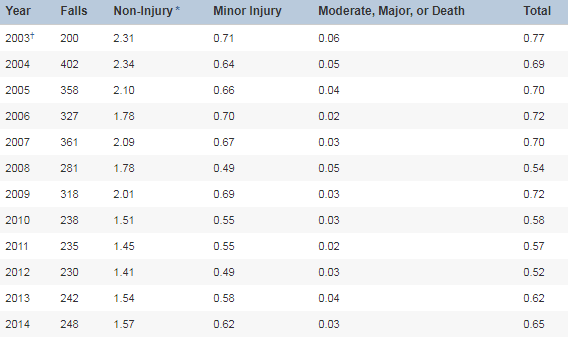
The first year, 2003, had only 200 falls because they started measuring in July. The first full year of measurement was 2004.
It would be easy to turn these into control charts, but the authors chose a boxplot with a trend line of predicted falls.
Continue Reading "Reducing Patient Falls – A Case Study"
Posted by Jay Arthur in Healthcare, Jay Arthur Blog, QI Macros, Six Sigma.
I have been thinking for some time that someone would come along, start buying up hospitals and forcing them to adopt the Lean principles of Amazon and Six Sigma to achieve the “science and evidence” that Don Berwick has been challenging the IHI to adopt.
Warren Buffet has the money, but usually invests in “well-run” companies, not ones in trouble. An estimated half of all hospitals are in financial trouble (often because of the lack of Lean Six Sigma).
Bezos and Amazon have the operational efficiency needed in virtually all healthcare environments.
Dimon has a big bank.
They are all worried about the quality of healthcare and the rising costs.
Continue Reading "Hospital Costs a “Hungry Tapeworm on U.S. Economy” says Warren Buffett"
Posted by Jay Arthur in Healthcare, Lean, QI Macros, Six Sigma.
May-June 2017 HBR discusses the results of a 10-year study of what makes CEOs great.
Of the four traits, number 4, Delivering Reliably, was found to be the most powerful of the four essential behaviors. Reliable CEOs were 15 times more likely to succeed.
I have found that one of the most effective ways to deliver reliably is to use Lean Six Sigma to simplify, streamline and optimize performance.
Continue Reading "Top Leaders Deliver Reliably"
Posted by Jay Arthur in Healthcare, Lean, Manufacturing, Service, Six Sigma.
Early in the movie, the McDonald’s brothers describe how they came up with the concept for speedy service. It’s Lean.
They had too many menu items, so they decide to simplify down to burgers, fries and soft drinks. (Think Lean inventory.)
They go to a tennis court and use chalk to lay out a possible floor plan to deliver service fast. One brother stands on a ladder watching while the employees pantomime cooking burgers, fries and soft drinks.
They go through several iterations to converge on their final design. (Think value stream mapping and spaghetti diagramming.)
I think they might have done it faster with cardboard boxes, but I wasn’t there.
Continue Reading "Lean Insights from “The Founder” Movie"
Posted by Jay Arthur in Healthcare, Lean, Manufacturing, Service.
October 2016 HBR article, Why Leadership Training Fails-and What to Do About It, calls the $160 Billion spent on training in the U.S. the Great Training Robbery. The authors say: “Learning doesn’t lead to better organizational performance, because people soon revert to their old ways of doing things.”
Unfortunately, this is true of most Six Sigma training courses. If you don’t apply what you’ve learned immediately to reducing delay, defects and deviation, the learning is lost in 72 hours.
That’s why my Lean Six Sigma workshops focus on solving real problems using existing data. Once people connect the methods and tools to results, it’s hard to go backward.
Continue Reading "The Great Training Robbery"
Posted by Jay Arthur in Healthcare, Lean, Manufacturing, Service, Six Sigma.
Over the last 25 years, I’ve gotten to see Six Sigma failures and successes. But in spite of all of the belts trained and investments made, why isn’t product and service quality any better? Why is there so much hassle? Why aren’t more customer experiences hassle-free? I’ve developed a mental list of the most common types of failures. Here’s my fishbone diagram for Six Sigma failures. I’d encourage you to develop your own.
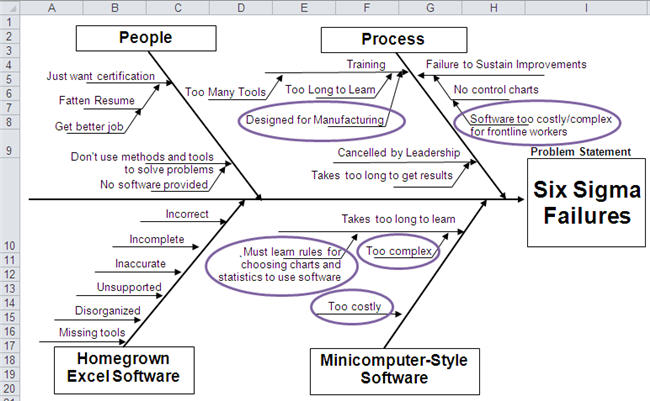
80% of the businesses in the U.S. are service businesses, yet Six Sigma training is extensively focused on the manufacturing factory floor. It takes too long to teach people everything they might need to know to solve all of the problems they might ever encounter.
Continue Reading "Why Six Sigma Fails"
Posted by Jay Arthur in Healthcare, Manufacturing, QI Macros, Service, Six Sigma.
I got a call from a QI Macros customer who works at a luxury car dealership. Customers were upset because their cars were spending too long in the shop. The dealership tracked the length of stay of every car, the symptoms and barriers to getting the car done when expected.
I was struck by the similarities between what he was describing and a hospital. Patients come in, get diagnosed, treated, admitted and eventually discharged. This is the same problem as the maintenance shop.
I asked if the maintenance department had information about the type of problem, missing parts, age of the car and so on.
Continue Reading "How is a Hospital Like a Car Dealership?"
Posted by Jay Arthur in Healthcare, Lean, QI Macros, Service, Six Sigma.
This month’s issue of Money Magazine discusses the 21 Most Valuable Career Skills. At the top of the list, statistical analysis increasing pay by 6.1%. Right behind statistical analysis is Data Mining at 5.1%. It’s incredibly easy to learn these two skills using QI Macros and Six Sigma.
Also on the list, Customer Service Metrics (4.3%). I have found that the written comments in customer service systems can be easily analyzed using the QI Macros Word Count tool to identify the most common type of call or complaint. Then simple root cause analysis can reduce or eliminate those calls.
Business analysis (3.8%) is easy with QI Macros Control Chart Dashboards.
Continue Reading "Most Valuable Career Skills"
Posted by Jay Arthur in Healthcare, Lean, Manufacturing, QI Macros, Service, Six Sigma.