Home »
Blog » QI Macros » Page 36
Improvement Insights Blog
Posts tagged "QI Macros"
Traditional Lean Six Sigma Training takes weeks when it’s possible to train people and get results in one day. Here’s why it costs so much to train people using last century strategies:
“I want to talk to you about the economics of a Six Sigma class. All right, so as much as I hate pie charts, I’m going to use one to demonstrate this. Let’s say you have a classroom and let’s say you have 20 odd people or something go in there. Now, I can tell you in advance every class is filled with three types of people: Prisoners, Vacationers and Learners.
Continue Reading "The Cost of Lean Six Sigma Training"
Posted by Jay Arthur in Agile Lean Six Sigma, Improvement Insights, Lean, QI Macros, Six Sigma.
Are you skipping Six Sigma stones across the surface of your business or are you finding people who take to it like a duck to water. People who can dive beneath the surface to find the invisible low-hanging fruit?
“Have you ever skipped a rock across a lake? Maybe the first time you threw it out there it just went “sploosh.” Then you figured out that flatter rocks skip better, so you started throwing them out and they’d go “skip-skip-sploosh,” or maybe get three or four or five “skip-skips” and “sploosh.”
“Then a duck came flying in, put out its landing gear and just kind of eased into the water.
Continue Reading "Skipping Stones or Diving Beneath the Surface of Your Business?"
Posted by Jay Arthur in Agile Lean Six Sigma, Improvement Insights, Lean, QI Macros, Six Sigma.
Over 140 people signed up for this webinar, with Jay Arthur demonstrating how to use some of the useful features of QI Macros, as well as some of the new features introduced in recent releases of the software.
Some attendees were familiar with the software and already use it, some had only begun to use it; all were interested in learning new ways that QI Macros can help them with their Agile Lean Six Sigma and Quality Improvement efforts. (You can hear him answering questions and comments typed in by webinar attendees.)
If you saw a feature demonstrated in the webinar that might have been added to QI Macros after the version you’re using (for instance, the Templates Wizard, the Fixed Limit indicator or the automated Process Change Wizard), you may need to purchase an upgrade to bring your QI Macros to the current version.
Continue Reading "6/9/20 QI Macros Webinar"
Posted by Jay Arthur in Data Mining, Excel, QI Macros, Webinar.
That's root cause analysis: What are the common patterns? Where's the Pareto principle?
Continue Reading "Root Cause Analysis in the Time of COVID-19"
Posted by Jay Arthur in Healthcare, Improvement Insights, QI Macros.
This is a fun thing we did last week. While Watching the movie “Forrest Gump,” Jay heard this song and had the idea that this song is particularly applicable to our current situation. Several of the people that work for QI Macros are musicians, so we tried to do something fun while we’re working remotely. This was recorded in 4 separate homes and then assembled and arranged by Nicholas. We hope you enjoy it:
Continue Reading "Let’s Work Together"
Posted by Jay Arthur in Jay Arthur Blog.
Humans, by nature, have a fear of looking bad (FOLB). And we have a fear of looking stupid (FOLS). These are slowing COVID-19 response and quality improvement. Here’s why:
Hi, I’m Jay Arthur, author of “Lean Six Sigma Demystified” and QI Macros [software].
“You’ve all probably all heard some of these acronyms that are running around like FOMO: Fear Of Missing Out. Well, I wanted to introduce you to a couple more that I’d like you to consider. FOLB: Fear Of Looking Bad.
“Now when I’ve gone out to work with companies in consulting roles, some of these managers think, “I’m supposed to be in charge of fixing everything.
Continue Reading "FOLB – Fear of Looking Bad"
Posted by Jay Arthur in Healthcare, Improvement Insights, Lean, Manufacturing, Six Sigma.
Over 120 people signed up for this webinar, with Jay Arthur demonstrating how to use some of the useful features of QI Macros, as well as some of the new features introduced in recent releases of the software.
Some attendees were familiar with the software and already use it, some had only begun to use it; all were interested in learning new ways that QI Macros can help them with their Agile Lean Six Sigma and Quality Improvement efforts. (You can hear him answering questions and comments typed in by webinar attendees.)
If you saw a feature demonstrated in the webinar that might have been added to QI Macros after the version you’re using (for instance, the Templates Wizard, the Fixed Limit indicator or the automated Process Change Wizard), you may need to purchase an upgrade to bring your QI Macros to the current version.
Continue Reading "5/14/20 QI Macros Webinar"
Posted by Jay Arthur in Data Mining, Excel, QI Macros, Webinar.
If COVID-19 has taught us anything, it’s that we can’t keep doing things the same old way. The status quo isn’t working for us anymore. We have to stop projecting the past (the way we’ve always done it) into the future. The future doesn’t have to be an endless rerun of the past.
“Hi, I’m Jay Arthur, author of “Agile Process Innovation”and QI Macros [software]. Here’s my Improvement Insight for this week: Stop projecting your past into your future.
“Way too many people do this, right? We start thinking, “Well, we’ve always done it that way so we have to always do it that way.”
Continue Reading "Stop Projecting the Past Into the Future"
Posted by Jay Arthur in Improvement Insights.
Control charts offer a promising way to analyze COVID-19 Data. Learn where to get the data, how to mine it and how to chart it in this video.
Continue Reading "Create a COVID-19 Control Chart Using QI Macros"
Posted by Jay Arthur in Ask Jay, Data Mining, QI Macros, Six Sigma.
People over age 55 account for 92% of COVID-19 Deaths (data from CDC). Sweden is using similar data to leave the country open for most citizens while asking seniors to stay at home. How do we reopen the economy? Self-quarantine seniors; let everyone else get back to work.
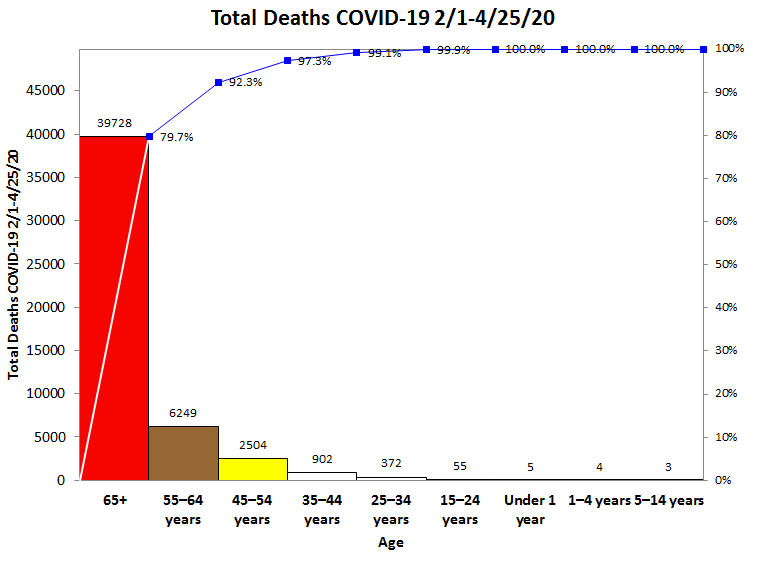
Here’s the 2019-2020 Influenza (i.e., Flu) deaths. Again, seniors are 83.5% of deaths. The flu death rate is about 1 per 1,000. COVID-19 death rate is 1-2 per 100, perhaps lower in people under the age of 55 and higher for those over age 55.
Countermeasure: Self-quarantining seniors will help flatten the curve and prevent overwhelming healthcare.
Continue Reading "U.S. Deaths by Age Group as of 4/24/2020"
Posted by Jay Arthur in Healthcare, Jay Arthur Blog, QI Macros.