Home »
Blog » Page 69
Improvement Insights Blog
Latest Posts
People sometimes hesitate to tackle the Big Hairy Audacious Problems (BHAP) using Six Sigma. They start with something trivial. Trivial problems have limited data. The BHAP problems have better, more detailed data.
Tackle the Worst First!
Continue Reading "Six Sigma Triage"
Posted by Jay Arthur in Improvement Insights.
If you’re not getting the results you want from Six Sigma, there might be a problem in the development of your projects.
Here are some of the mistakes I see in Six Sigma projects.
Continue Reading "More Six Sigma Project Mistakes"
Posted by Jay Arthur in Improvement Insights, Six Sigma.
I believe we are teaching people things they don’t need to know to solve problems they don’t have to impress people they don’t like.
You don’t have to know everything about statistics to do Six Sigma projects. What you need to know adheres to the 4/50 Rule: 4% of the knowledge will deliver over 50% of the results.
And if you automate the formulas and decision trees using QI Macros, you can collapse the learning curve in such a way that “No Belts” can go from zero to hero in a matter of hours. Here’s how:
Continue Reading "Collapsing the Six Sigma Learning Curve"
Posted by Jay Arthur in Improvement Insights, QI Macros, Six Sigma.
Remember how you learned things when you were a kid? That’s not how anyone teaches Lean Six Sigma, but it could be.
Continue Reading "Show-Do-Know – The Secret to Accelerated Learning"
Posted by Jay Arthur in Improvement Insights, QI Macros, Six Sigma.
One of our QI Macros users sent me a Greenbelt Project to review. The team did a great job of using the tools and connecting the dots. There was only one small problem…
Continue Reading "Six Sigma Green Belt Project Problem"
Posted by Jay Arthur in Improvement Insights, QI Macros, Six Sigma.
Most of the improvement posters at this year’s Institute for Healthcare Improvement (IHI) conference are still using line, bar and pie charts, not the tools of quality improvement. There were several posters using QI Macros control charts, Pareto charts and fishbones this year from Sutter Health and Howard University Hospital.
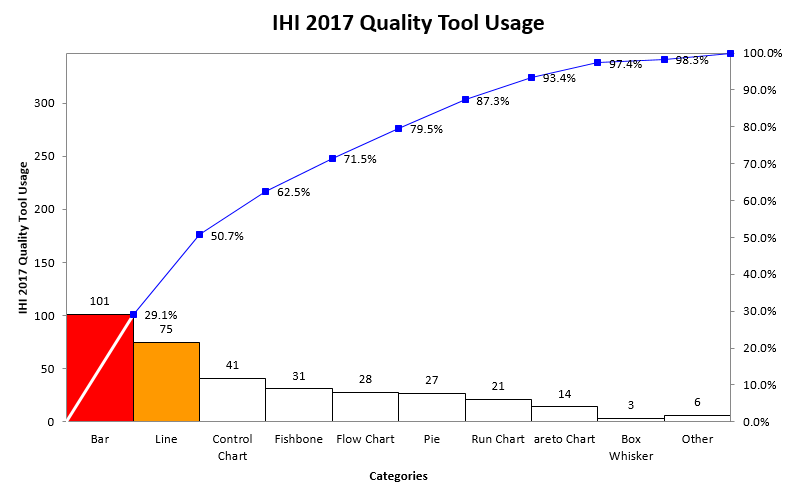
Continue Reading "IHI 2017 Quality Tool Usage"
Posted by Jay Arthur in QI Macros, Six Sigma.
People have been trying to make statistics simple and easy to understand for decades.
But statistics aren’t simple. Maybe we should change how we teach them?
Continue Reading "Statistics are Simple"
Posted by Jay Arthur in Improvement Insights, QI Macros, Statistics.
Everyone seems to think that top down, leadership-driven is the only way to implement Lean Six Sigma. It’s not.
50 years of research proves that it fails half the time. Yep, 50% failure rate. That’s less than 1 sigma.
This type of failure is so common that it even has a name: The Stalinist Paradox.
Continue Reading "Top Down Change Doesn’t Work"
Posted by Jay Arthur in Improvement Insights, Lean, QI Macros, Six Sigma.
The recent collapse of GE stock price has led to a lot of discussion. Here’s my two cents.
Jack Welch implemented Six Sigma at GE which drove many CEOs to do the same. From scuttlebutt I’ve picked up over the years, this lead to crazy rules like every employee had to do two Six Sigma projects a year. This would violate Pareto’s Rule: if only 20% of the business is creating 80% of the defects, waste and rework, having employees try to fix the remaining 80% of the business is a waste of resources. Six Sigma needs focus, not spread.
Jeffery Immelt reduced leadership support for Six Sigma.
Continue Reading "GE’s Problems – Strategy or Six Sigma?"
Posted by Jay Arthur in QI Macros, Six Sigma.
“Our evolutionary instincts sometimes lead us to see patterns when there are none there. People have been doing this all the time – finding patterns in random noise.” – Tomaso Poggio
People just need a way to separate the Signal from the Noise.
Here are some insights from the book by Nate Silver.
Continue Reading "Signal versus Noise"
Posted by Jay Arthur in Data Mining, Improvement Insights, Jay Arthur Blog, Six Sigma.