Home »
Blog » Six Sigma » Page 25
Improvement Insights Blog
Latest "Six Sigma" Posts
Every businesses wastes a quarter to a third of total expenses 1) fixing stuff that shouldn’t be broken (rework) and 2) throwing away stuff that can’t be fixed (scrap). There are four main costs of poor quality:
- Internal failures that cause rework and scrap.
- External failures that increase returns (to be reworked or scrapped), billing adjustments, concessions and customer complaints.
- Inspection costs of incoming materials,inspection of work in process and final inspection and testing.
- Prevention costs (i.e, Lean Six Sigma)
Inspection, failure, rework and scrap can easily devour much of a companies time and money. Preventing these problems is far less expensive, but requires focus and dedication to eliminate mistakes and errors.
Continue Reading "Cost of Poor Quality"
Posted by Jay Arthur in Six Sigma.
I have found that a high number of people have a fear of math. They seem to think that you are either born with math skills or you aren’t.
In the Jan/Feb 2016 Scientific American Mind, author Carol Dweck reviews the most recent research into The Remarkable Reach of Growth Mind-Sets.
One study by Kathy Liu Sun found that middle school math teachers that embraced growth mind-set but did not back it up with growth mind-set teaching methods such as emphasizing underlying concepts, giving feedback and giving students a chance to revise and resubmit their work caused their students to develop a fixed mind-set.
Continue Reading "Is a Fear of Math Stopping Your Six Sigma Projects?"
Posted by Jay Arthur in QI Macros, Six Sigma.
Steve Harvey misread the results of the final ballot at the Miss Universe 2015 pageant. Was it the cue card or the teleprompter?
Here’s the cue card:

Could the card have been designed in ascending order?

Did the teleprompter operator misread the card or Steve?
Is this the same problem the U.S. had with the “hanging chad” in the 2000 presidential election in Florida?
Is bad form design causing mistakes and errors?
Continue Reading "Miss Universe 2015 Cue Card Redesigned"
Posted by Jay Arthur in Jay Arthur Blog, Six Sigma.
For many years, I’ve been endlessly annoyed by the mistakes and errors of every service and product business I use. From crappy cell phone service to mistakes on restaurant bills. I have hesitated to write about these experiences because it seemed too much like whining, but my daughter Tina introduced me to the concept of the “Burnt Toast Society.”
Burnt Toasters will eat burnt toast at a restaurant rather than send it back. I think American consumers put up with too much mediocrity. So I have decided to start complaining online about every burnt toast experience.
I recently flew back on Frontier Airlines from the Institute for Healthcare Improvement (IHI) conference in Orlando.
Continue Reading "The Burnt Toast Society"
Posted by Jay Arthur in Six Sigma.
At IHI 2015, the National Patient Safety Foundation released its new report Free From Harm. Download from www.npsf.org/free-from-harm. The nuts-and-bolts of the report: patient safety is still a big problem. The report recommends eight steps to rapidly improve patient safety.
Some hospitals are already using “High Reliability Healthcare” methods (Lean, Six Sigma and Change Management) to drive harm to ZERO. Memorial Hermann Hospital has had ZERO hospital acquired infections (HAIs) for multiple years. ZERO complications from blood transfusions. Memorial Hermann made Patient Safety their CORE VALUE and has pursued it relentlessly. And they are not alone.
The new standard for patient safety is ZERO defects, mistakes and errors.
Continue Reading "Hospital’s New Goal – Zero Harm"
Posted by Jay Arthur in Lean, Service, Six Sigma.
In his speech Sunday at IHI, Don Berwick called for everyone to “recommit to improvement science” (step 5 in ERA 3 of healthcare transformation).
He sounded annoyed with the lack of use of Lean Six Sigma tools and methodologies.
I understand his frustration. I was there in 2006 when he asked everyone to “pledge allegiance to science and evidence.”
Over the years, I’ve done a stroke tally of the quality tools used in IHI poster presentations.
I gave each poster one checkmark for each type of tool used.
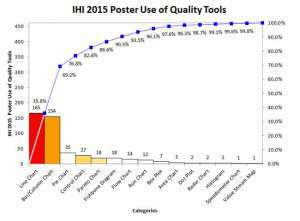
Sadly, even with all of the emphasis on control charts, Pareto charts and other tools of quality, they are used rarely in poster presentations.
Continue Reading "IHI 2015 Poster Use of Quality Tools"
Posted by Jay Arthur in Healthcare, QI Macros, Six Sigma.
The July-August 2015 Harvard Business Review has an article by Particia McDonald, Robert Mecklenburg, MD. and Lindsay Martin on how Intel is driving reduction in health care costs. Intel was projecting that healthcare costs would hit $1 Billion a year in 2012.
Using Virginia Mason’s approach to Lean Healthcare, Intel worked with Cigna and a newly formed Healthcare Marketplace Collaborative (HMC), they were able to reduce the costs of the three most common treatments by 24% to 49%. Evidence based care and eliminating unnecessary tests and care cut more than 10,000 hours from healthcare processes.
Goals: Same-day access to care and rapid return to work.
Continue Reading "Employer-Led Health Care Revolution"
Posted by Jay Arthur in Lean, Service, Six Sigma.
At the ASQ Lean Six Sigma Conference, the QI Macros booth was right next to my biggest competitor–the big dog in the market (you know who they are). A guy comes up to me and says: “We bought 150 copies of their product (pointing to the booth next to me) and it was really expensive. I asked our Green Belts if they were using it and they said No, it’s too hard to use. What are they using; they said Excel.” He went on to say: “I’m thinking about getting the QI Macros because everyone is comfortable with Excel.”
And he wasn’t the only attendee who complained about the same issues: costs too much and too hard to use.
Continue Reading "Complex Statistical Software–a Barrier to Six Sigma"
Posted by Jay Arthur in QI Macros, Six Sigma.
I had a breakfast burrito at the Marriott in San Diego last week. I cut it in half and took a bite. I realized there was somthing amiss when I pulled out a strip of plastic. I tried to pull it apart, but it wouldn’t break.
I showed it to the cafe staff and she said: “It looks like an onion.” But a cooked onion would pull apart; the plastic didn’t. I got my money back.
I can imagine that if a machine is cutting onions into strips that it would cut plastic as well. Then the plastic just looks like an onion strip in the egg.
Continue Reading "The Plastic Breakfast Burrito"
Posted by Jay Arthur in Manufacturing, Service, Six Sigma.
The April, 2014 Harvard Business Review has an article about creating a culture of quality. The authors found that a culture of quality will save $13,400 per employee per year. Surveyed participants also said it takes two hours to fix a mistake. Joseph Juran often said that companies lose a quarter (25%) of their revenue finding and fixing mistakes and errors, so this gives us a benchmark and a reason to embrace quality.
“Companies that take a grassroots, peer-driven approach develop a culture of quality. Traditional strategies have little effect.”
Four Factors that Drive Quality
- Leadership – As Deming said: “The aim of superision should be the help people and machines and gadgets do a better job.
Continue Reading "Creating a Culture of Quality"
Posted by Jay Arthur in Lean, Manufacturing, Service, Six Sigma.