|
© 2007KnowWare
International, Inc. DBA LifeStar
2253 S. Oneida St., Ste 3D
Denver, CO 80224
Jay Arthur
888-468-1537
303-756-9144
Email Us

We help people think!
|
|
Lean Six Sigma Software, Training, Consulting and Resources
Faced with rising costs and shrinking profits?
Learn streamlined methods to boost productivity and profits using Lean
Six Sigma.
I spent 21 years working in various parts of the Bell System-one of the
biggest and best cash cows of the last century. Like most businesses,
managers and employees used trial-and-error-the slowest method of improvement-to
reveal common sense ways to better the business.
In 1990, the Baby Bell I worked for started to implement TQM-Total Quality
Management. We trained team members and team leaders (greenbelts and blackbelts)
and started hundreds of teams. Frustrated by the glacial slowness and
paltry returns, a few of us started to look for ways to use TQM to drive
breakthrough improvements.
The first successful improvement project I worked on involved just myself
and the building manager. It seemed that we'd had a higher number of false
fire alarms than expected back in 1992. In just under four hours, we traced
the root cause to fire detectors that were being triggered by cell phones.
This kicked off national standards work to improve fire alarms. We were
able to reduce false fire alarms from 11 per year to just one.
In subsequent years I lead teams that, in a matter of months, saved $20
million in postage expense and $16 million in adjustment costs. In 2000
I worked with a wireless company who reduced order errors from 20% to
3% in just four months saving $250,000 a month.
Has your business grown into a cash cow? Are you comfortable with
your current level of productivity and profitability? Or do you still
have a nagging feeling that it could be significantly higher? Well it
can be and here's why: I have found that virtually all companies grow
from wobbly startups into a cash cows using trial-and-error and common
sense, but then most companies simply stop improving. They reach the
limit of what's possible using common sense alone. Just like the human
eye can only see certain wavelengths of light and can't see deep into
space or a drop of pond water, the human mind can only see obvious problems
and improvements.
Most companies "hit the wall" when they reach 1%, 2%,
or 3% error levels in marketing, sales, ordering, fulfilling, and billing.
Across the enterprise, this adds up to 6-12-18% error. And each of these
errors costs far more to fix than they did to create. I have found that
3% error (30,000 parts-per-million or 3-Sigma) is where common sense stops
working. Common sense, the very thing that took you to sustainable profitability,
will take you no farther. To turn your Cash Cow into a Golden Goose you
will need the common science of Lean Six Sigma to rise to 5-Sigma (less
than 300 PPM). Here's why:
Every company has two "factories:" one that creates and
delivers your product or service, and a hidden "Fix-it" factory
that cleans up all of the mistakes and delays that occur in the main factory.
If you're a 3-Sigma company, the Fix-it Factory and those 30,000 defects
per million (PPM) are probably costing you $25-$40 of every $100 you spend.
If you're a $10 million company, that's $2.5-$4 million that could be
added back to your bottom line using the common science of Lean Six Sigma.
In a $1 billion company, that's $250-$400 million. And I have found that
it's relatively easy to shift at least 10% out of your Fix-it factory
in 12-18 months. Whether it all flows to the bottom line or you use it
to grow your business is up to you. Every one penny improvement in profits
per share can increase shareholder value by millions of dollars.
Here's what you can accomplish with Lean and Six Sigma:
1. Double Your Speed - reduce delay and idle
time. Most companies have extensive delays built into their processes.
It usually takes no more than two days to flowchart the process, eliminate
the delays, and slash your cycle time by 50% or more.
2. Double Your Quality - by reducing
mistakes, errors, and defects by 50% or more. Using your existing data,
you can identify where to search for the hidden gold mine in your business
in as little as three days. Properly focused, teams can find the root causes
of common errors in one day or less.
3. Increase your profits and grow your business by slashing the cost
and delays associated with the Fix-It Factory. Every dollar you waste in
the Fix-it Factory is a dollar you could be adding to your bottom line.
Order Now
What is Lean?
Lean thinking focuses on removing the non-value added (NVA) delay, waste,
and rework from your processes. Lean can be used in any industry
or business. While it comes from the Toyota Production System, it can be
used to streamline and accelerate patient flow in hospitals or transaction
processing in computers.
What is Lean Six Sigma?
Lean Six Sigma is an aggressive method for breakthrough improvement in speed,
quality and cost. When implemented properly, Lean Six Sigma focuses on results,
not training. Instead of measuring errors in percentages, you measure them
in parts per million (PPM).
Most newly implemented processes or software applications have error rates
of 20-30% (300,000 PPM-2 sigma). When the economy turns down or sales heat
up, the costs of fixing these defects can easily put a stranglehold on the
company. The dot-coms learned this the hard way in 2000.
Over time, these business processes get to error rates of around 3% (30,000PPM-3.5
sigma), but it's slow, expensive, and takes a long time. Because you can
be profitable at this level, most companies fail to go any farther. But
failure to "raise the bar" leaves you vulnerable to "quality"
competitors. The auto industry learned this from Japanese competition in
the 1980s.
What is Lean Six Sigma Simplified?
Most companies spend $15,000 to $40,000 to train a "black belt"
in all of the exotic statistical tools necessary to solve all of the possible
problems in a manufacturing or service business. But to go from 3 Sigma
(30,000 PPM) to 5 Sigma (300 PPM), you don't really need all of the exotic
statistical tools, you only need the common science of Lean Six Sigma: a
few key tools and laser focus. Have you ever noticed that to maximize your
results in any endeavor you don't usually need to know everything, just
a few essential elements? The same is true with Lean Six Sigma. With just
a few key tools-line, pareto, fishbone, and control charts-most companies
can easily and routinely find ways to save big bucks and add them to the
bottom line.
If it costs $10 to fix just one error, then going from 30,000ppm to 300ppm
will prevent 29,700 errors and save $297,000. But there are additional costs
of fixing an error-lost productivity (another $10), downstream costs ($10-$80),
and lost sales from lost productivity and poor quality. In reality, a typical
defect or error can cost $50-$100 or more when you add in all of the related
costs. Order Now!
What is the Lean Six Sigma Process?
The new acronym is DMAIC (define, measure, analyze, improve, control). For
most people this quality jargon is still confusing, and the underlying process
and tools are identical to TQM! It's simply a new map to a well established
territory. So I created the following simple acronym:
| FISH |
Step |
Activity |
Tools |
| Focus |
1 |
Focus with laser-like precision for maximum results
with minimum investment |
Line Graph
Pareto Chart |
| Improve |
2 |
Reduce delay, defects, and costs by 50% in your mission-critical
systems (not all of them) |
Fishbone Diagram |
| Sustain |
3 |
Stabilize and sustain the improvement to retain the
benefits |
Control Charts |
| Honor |
4
|
Recognize, review and refocus efforts on the next set
of mission-critical problems |
Tree Diagram |
Implementing Lean Six Sigma
The tools of Lean and Six Sigmawork flawlessly, but over 50% of TQM implementations
failed. The same appears to be true in Lean Six Sigma. The failure is caused
by implementation, not the methodology. In the Baby Bell, we took an "all-or-nothing"
approach to implementing TQM: 100s of teams and weeks of training. Months
went by and years went by with little to show for it. To make TQM work,
we had to go back to basics: laser focus using existing data, improve the
mission critical processes, sustain the improvement, and honor our progress.
Most Lean Six Sigma "Black Belt" systems are taking the
"all-or-nothing" approach that requires massive investments in
training and up to a year before you start seeing any benefit. This "bet
the business" approach is hazardous. Instead, you might consider a
"crawl-walk-run" approach that will let you maximize your return
while minimizing your initial investment. Here's why:
The 4-50 Rule: In case after case working with various businesses,
I have found that less than 4% of your business causes over 50% of the waste,
rework, cost, and lost profit. So forget the old 80/20 rule. Narrow your
focus even further to maximize your gains and minimize your Lean Six Sigma
startup costs. Only involve 4% of your staff in the initial wave of improvements;
in a small business that might be two people looking at data for an afternoon.
Start "crawling" with Lean Six Sigma so that you have time to
understand and adapt the approach to your business. Then "walk"
your way to success on the next 4, and then the next 4%. Here's why:
Research into how groups of people adopt, adapt or reject changes proves
that transformational change begins with less than five percent of the work
force. After several "waves" of improvement, these initial explorers
will create the "critical mass" necessary for a change like Lean
Six Sigma to take root, grow, and spread rapidly across the organizational
landscape.
Remember the dark side of the 4-50 rule: 50% of your effort only produces
4% of the benefit. Why bother? Why waste your hard-earned dollars by spreading
them over the entire organization, when you can focus and achieve results
in just a few key areas. Then, like seeds in the wind, word of mouth will
spread the change to a few neighbors, and before long, the employees will
convert with minimal resistance and expense.
Start small, focus on mission critical issues, and start driving results.
In my experience, it only takes a matter of a few days to find and solve
some of the key problems in any business. It may, however, take a little
longer to implement the solutions, but better soon than never. Just use
the simple tools of Lean Six Sigma Simplified. Click
Here
How is Lean Six Sigma Simplified Different?
| Most Lean Six Sigma Programs |
Our Suggested Lean Six Sigma System |
| All-or-Nothing |
Crawl-Walk-Run |
| Commit to widespread, high-cost, long-term Lean Six
Sigma implementation |
Laser focus your implementation on the mission critical
portions (often less than 4%) of your business that cause over 50%
of the delay, defects, waste, rework, and cost. This will minimize
your cost while maximizing your benefit. It also maximizes the likelihood
of success with Lean Six Sigma. |
| Commit to company-wide training that takes 1-4 weeks
and $15,000 per black belt |
Use just-in-time training with teams focused on mission
critical improvements. Develop people who can find the "mother
lode" in your business. Lean Six Sigma should be about results,
not training. |
| Randomly pick and train black belts in all of the exotic
improvement tools |
Establish a track record of success using the fundamental
tools of improvement-what I call common science. Then identify the
individuals with the people, process, and technical skills to become
your black belts. |
| Wait 9-12 months for results |
Get immediate results in 3-6 months. |
Don't Make the Same Mistakes
Many companies embarking on the Lean Six Sigma quest are making the
same mistakes they made only a few years ago with TQM: measuring progress
by people trained, not results achieved. They are trying to train everyone,
when it is costly and counterproductive to do so. Here's what I've found:
- 4% of your business produces over 50% of the defects, time, and
cost that dampens your productivity and profitability. Why train
everyone? Use the data you already have to focus the improvement effort
and only train the 4% of your employees who work in these high priority
areas.
- Set a BHAGBig Hairy Audacious Goalto reduce cycle
time, defects, or cost by 50% or more in less than six months.
Most startup companies are at about 2.5 Sigma (17% defects) and most
existing companies are at about 3.5 Sigma (3% defects-30,000/million).
Using only a line graph, pareto chart, and a fishbone diagram, any company
can move up to 5 Sigma (300 defects/million) in 18-24 months. And when
you do, you'll stop squandering your profits fixing defects you created
along the way. You'll free up people to do meaningful, productive work
for your customers. And, best of all, you'll begin to differentiate yourself
from all the other companies who produce similar products and services.
Haven't you waited long enough to start achieving these kinds of breakthroughs
in speed, quality, and profitability? And you don't have to spend a fortune
to do it. The complete Lean Six Sigma Simplified
System is only $499 including shipping, order
now. You might spend $15,000 or more training one "black belt."
When you get to 5 Sigma, you'll need one, but why not start simply with
a proven system for process improvement that delivers 50% or greater improvements.
It's up to you.
Get Started Now
Start by downloading our " Free Six Sigma Action Plan
(see Free Stuff)" that gets you on track to breakthroughs in
productivity and profitability using a proven method for systematic improvement
that won't cost you a fortune."
Ten Reasons To Choose Our Lean Six Sigma Products and Services
1. Longevity! We've been in business since 1992 with thousands of
satisfied users of our Lean Six Sigma software and training products.
2. Save Time and Money! With our unique "crawl-walk-run"
approach to Lean Six Sigma, you can train teams in as little as two hours
and get results in three months or less using a proven Lean Six Sigma
system!
3. Money Back Guarantee! If you are not completely satisfied with
your product or service, just return the product and you owe us nothing!
4. Simplicity! We have found that a few key tools, used in the
right sequence with the right focus can generate monsterous results. We
don't teach everything there is to know about quality, just the essence
to success.
5. Robustness! The QI Macros provide most of the tools you will
need as your Lean Six Sigma skills develop. Tools like QFD, DOE, and GageR&R.
6. Open Source! The QI Macros are written in Excel Macro language
that you can modify to meet your own specific needs!
7. No Hassles! We offer a risk-free, 30-day trial of any of our
products. If you don't like them for any reason, just return them. No
questions asked!
8. Pricing! Where else are you going to find a complete Lean Six
Sigma System that can easily take you from 3-to-5 Sigma and save you 10%
of your current expenses for only $499? Or Lean Six Sigma software that
runs in Microsoft Excel for only $139? This means that you can get 10
copies of the QI Macros for less than the cost of one copy of Minitab.
9. Information! With our qimacros.com website and monthly ezine
you can stay up-to-date on the latest Lean Six Sigma information. You
can also download our FREE "Money-Belt" Action Plan and limited
demo of the QI Macros that will let you get started solving problems today!
10. Support after the Sale! Once you start using the Lean Six Sigma
System, you may need specialized guidance, tools or case studies. We can
consult with you online or onsite to laser-focus your Lean Six Sigma efforts.
We can program customized tools or case studies for your specific needs.
And we have an online "Six Sigma Wizard" to help you "do-it-yourself."
To your success with Lean Six Sigma,

Jay Arthur
P.S. People sometimes ask: "Jay, why are you doing this?" You're
almost "giving away" the keys to Lean Six Sigma.
I agree. The secrets of success with Lean Six Sigma that I've distilled
over the last decade are valuable, but the quality community has made
it so complex and jargon-laden that somebody has to make these powerful
tools available to all businesses, large and small.
It makes me mad to see the misinformation about implementing Lean Six
Sigma. Lots of companies are going to try and most are going to fail,
because they're using the same strategies for Lean Six Sigma that didn't
work for TQM.
So, I've decided to share everything I've learned for a fraction of what
we could charge. And you're the beneficiary...if
you act now. Click here.
© 2007 KnowWare International Inc. (888) 468-1537
knowwareman@qimacros.com
Home
| Lean Six Sigma
| QI Macros
| KnowWare
| Site Map
|
Do you have the right mindset
for Lean Six Sigma?
Click Here To Find Out Now!
New Book!

New Video!
Customer Success!
E-470
Public Highway Authority Wins 2006 Toll Excellence Award from
IBTTA for:
New Rules for the Road: Improving Performance with Statistical Controls
Visit Our Booth at Upcoming Conferences
Food Safety Summit #235
Mar 17-19
ASQ #233
May 4-6
Quality Expo-#524
June 11-12
Or Buy It Now!
Unconditional
90-Day
Money-Back
Guarantee
The QI Macros for Excel $139,
is an inexpensive easy to use set of Excel add-ins for statistical process control
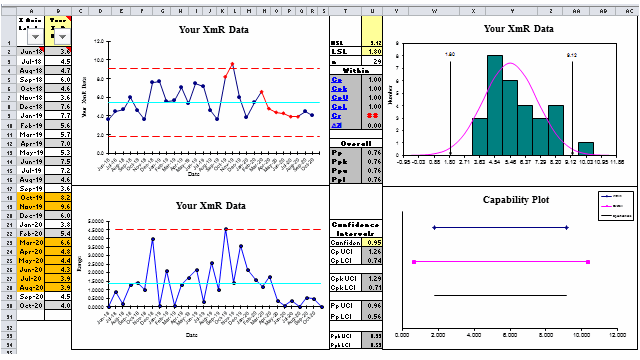
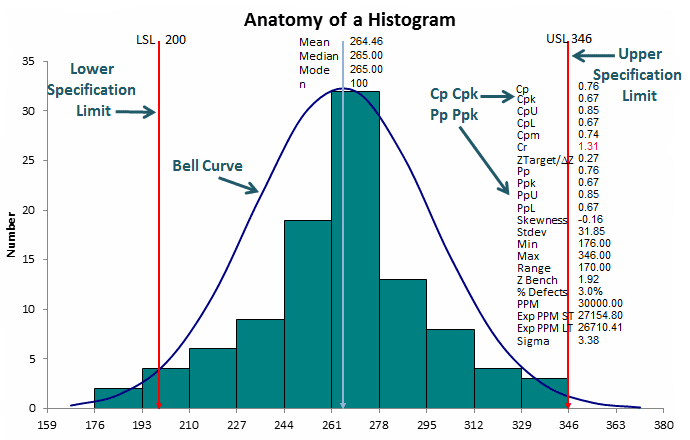
and Lean Six Sigma. It draws line, pie, bar, pareto, box whisker, histogram (Cp,
Cpk), scatter and control charts (with stability analysis).
It contains over 70 fill in the blank templates such as the Ishikawa diagram,
QFD, DOE, FMEA, PPAP, and Gage R&R for MSA. Performs ANOVA, t-test, F-test,
and regression analysis.

Quantity Discounts
Customer Testimonials
Minitab Comparison
QI Macros FAQs
Lean
Six Sigma Overview Presentation
Plug the
Leaks in Your Cash Flow
New Blog:
Plug the Leaks In Your Cash Flow
New!
Six Sigma Golf
Improve your golf game with Six
Sigma. Click Here!
Free Lean Six Sigma Articles
Free QI Macros - Excel Tips
Real Time SPC Tool
|